
Showing posts with label Politics. Show all posts
Showing posts with label Politics. Show all posts
Wednesday, April 14, 2010


Sunday, November 22, 2009
Health Care - Where Can I Get A Life Boat?
One of my favorite quotes of Ayn Rand comes from We The Living:
"Do you believe in God, Andrei? No. Neither do I. But that's a favorite question of mine. An upside-down question, you know. What do you mean? Well, if I asked people whether they believed in life, they'd never understand what I meant. It's a bad question. It can mean so much that it really means nothing. So I ask them if they believe in God. And if they say they do—then, I know they don't believe in life. Why? Because, you see, God—whatever anyone chooses to call God—is one's highest conception of the highest possible. And whoever places his highest conception above his own possibility thinks very little of himself and his life. It's a rare gift, you know, to feel reverence for your own life and to want the best, the greatest, the highest possible, here, now, for your very own."
My new favorite question is "Do you believe that the government should provide health care?" I think the answer to this question tells me more about a person's view on individual liberty than anything else I could ask.
Anyway, if the health care public option bill passes after the debate in the Senate floor... I think I'll be ready to admit that we are all on a sinking titanic and start looking for a life boat.
"Do you believe in God, Andrei? No. Neither do I. But that's a favorite question of mine. An upside-down question, you know. What do you mean? Well, if I asked people whether they believed in life, they'd never understand what I meant. It's a bad question. It can mean so much that it really means nothing. So I ask them if they believe in God. And if they say they do—then, I know they don't believe in life. Why? Because, you see, God—whatever anyone chooses to call God—is one's highest conception of the highest possible. And whoever places his highest conception above his own possibility thinks very little of himself and his life. It's a rare gift, you know, to feel reverence for your own life and to want the best, the greatest, the highest possible, here, now, for your very own."
My new favorite question is "Do you believe that the government should provide health care?" I think the answer to this question tells me more about a person's view on individual liberty than anything else I could ask.
Anyway, if the health care public option bill passes after the debate in the Senate floor... I think I'll be ready to admit that we are all on a sinking titanic and start looking for a life boat.
Thursday, November 12, 2009
On HealthCare
Here is and interesting interview of David Goldhill, the author of the stunningly coherent article "How American Health Care Killed My Father". If you have ever been confused the the debacle that is our health care system, this is the article for you. How is it that doctors can't be bothered to wash their hands properly? How come the doctor gives you a stunned stupid expression of incomprehension when you ask what something costs? Why is my health care stuck to my employer instead of to me? How is it that both doctors AND insurance companies claim their not making enough money? I literally felt the confusion fall away when I read this article, I highly recommend it. And I'm super grateful to APOS for sending it to me.
Video below:
Video below:
Thursday, October 29, 2009
Comical discomfort with the human body.
This is outrageous and funny all at the same time:
The poor guys just trying to get his morning pick-me-up and suddenly the cops are involved. I personally think its obvious enough that this was not crime that the arresting officers should be liable for grief they've caused the guy. It sounds like the state has zero chance of convicting him, but it could be an interesting jump off point for a discussion of property rights. The guy was in his own home on his own property. The person who saw him was IN HIS YARD. She was peering into his home early in the morning. What obligations does a person have the power to impose on you without your knowledge simply buy peeping into your window? How does the fact that she was and is free to make it a habit not to look into people homes apply to the question? How would the situation change if she was standing on the public right of way? Would it change at all? What percentage of people do you suppose could be arrested for the same crime of daring to be naked in their own home without bolting all the shudders? My guess is its north of 99.99% and the people aren't guilty likely have some deep seated issues.
BTW by what stretch of the imagination are we supposed to believe that the mere, momentary sight of another human being sans clothing could somehow damage either the woman or the little boy?
We're all just folks, one built same as the last. If you don't like the view move along.
The poor guys just trying to get his morning pick-me-up and suddenly the cops are involved. I personally think its obvious enough that this was not crime that the arresting officers should be liable for grief they've caused the guy. It sounds like the state has zero chance of convicting him, but it could be an interesting jump off point for a discussion of property rights. The guy was in his own home on his own property. The person who saw him was IN HIS YARD. She was peering into his home early in the morning. What obligations does a person have the power to impose on you without your knowledge simply buy peeping into your window? How does the fact that she was and is free to make it a habit not to look into people homes apply to the question? How would the situation change if she was standing on the public right of way? Would it change at all? What percentage of people do you suppose could be arrested for the same crime of daring to be naked in their own home without bolting all the shudders? My guess is its north of 99.99% and the people aren't guilty likely have some deep seated issues.
BTW by what stretch of the imagination are we supposed to believe that the mere, momentary sight of another human being sans clothing could somehow damage either the woman or the little boy?
We're all just folks, one built same as the last. If you don't like the view move along.
Tuesday, October 20, 2009
The Buisiness of Marriage 2 - The Plot Thickens
Posted as a comment on The Business of Marriage
On the surface, it might appear as though the State's authority to approve a marriage is required because of its needed involvement when things go south in a bad marriage. Legal separation, custody battles, the traditionally-required alimony become the State's problem when two not-so-happy-ever-after-the-wedding parties decide to break up a marriage. So we can try to conclude right here that a State needs to authorize a union just so it can "fairly" unauthorize it.
"But aha", cry Apos and Trisco (they both actually and separately did, when I presented this argument to them), "why can't marriage then be just like another business contract? A contract that can be drawn up between two separate parties, albeit with a notary present, and doesn't require a license , State's approval, definitely no tax breaks and can still be a legal basis for fairness when the parties break the contract!"
That's a great point. So why can't a marriage just be a business contract? Lets dig deeper.
A marriage is a legal union of two individuals. The State has to be in the dirty business of this union because it has put itself in the dirty business of approving of who is legally an individual! The State is in one's life to begin with (that's right ...at the moment when you were born and had no idea of what's right and what's wrong - in the hospital...right after you blink your pretty little eyes at your loving mom). Must to Realism's outrage and Nihilism's delight, you don't really exist as an individual until the State grants you an existence license in the form of a birth certificate. And in fact, it's even consistent in handing out a nice tax break, albeit to your parents, for your recent appearance in this world. The State is there to begin with - without this birth certificate, you cannot get a drivers license, a passport or hell, even a marriage license. Since we all have implicitly accepted this power of the State to authorize the existence of an individual, by extension we have to accept (damn, logically, for rationality's sake, we have to demand !) the State's power to grant the union of two individuals as a single entity (and again by extension, demand a tax break for the same).
You cannot drink, travel, drive, earn, move, own, marry, and technically exist, without the State's consent.
Realism squirms and Nihilism shrugs as we walk away with our driver's license secure in our pockets.
ps: As a side note, it is very interesting how the tax breaks encourage the traditional role of a female as a home-keeper. The tax breaks, when filing as a couple, help only those whose incomes are very lopsided (maximized when only one person earns). In fact, if you have a spouse who makes the same amount (albeit extremely low), you are better off filing separately. Being single, why do I know this? Coz,I am suspicious of Govts. trying to nudge the masses. With nudge comes power (and we all know with great power comes current squared times resistance :P). And marriage is a classic instance of this.
On the surface, it might appear as though the State's authority to approve a marriage is required because of its needed involvement when things go south in a bad marriage. Legal separation, custody battles, the traditionally-required alimony become the State's problem when two not-so-happy-ever-after-the-wedding parties decide to break up a marriage. So we can try to conclude right here that a State needs to authorize a union just so it can "fairly" unauthorize it.
"But aha", cry Apos and Trisco (they both actually and separately did, when I presented this argument to them), "why can't marriage then be just like another business contract? A contract that can be drawn up between two separate parties, albeit with a notary present, and doesn't require a license , State's approval, definitely no tax breaks and can still be a legal basis for fairness when the parties break the contract!"
That's a great point. So why can't a marriage just be a business contract? Lets dig deeper.
A marriage is a legal union of two individuals. The State has to be in the dirty business of this union because it has put itself in the dirty business of approving of who is legally an individual! The State is in one's life to begin with (that's right ...at the moment when you were born and had no idea of what's right and what's wrong - in the hospital...right after you blink your pretty little eyes at your loving mom). Must to Realism's outrage and Nihilism's delight, you don't really exist as an individual until the State grants you an existence license in the form of a birth certificate. And in fact, it's even consistent in handing out a nice tax break, albeit to your parents, for your recent appearance in this world. The State is there to begin with - without this birth certificate, you cannot get a drivers license, a passport or hell, even a marriage license. Since we all have implicitly accepted this power of the State to authorize the existence of an individual, by extension we have to accept (damn, logically, for rationality's sake, we have to demand !) the State's power to grant the union of two individuals as a single entity (and again by extension, demand a tax break for the same).
You cannot drink, travel, drive, earn, move, own, marry, and technically exist, without the State's consent.
Realism squirms and Nihilism shrugs as we walk away with our driver's license secure in our pockets.
ps: As a side note, it is very interesting how the tax breaks encourage the traditional role of a female as a home-keeper. The tax breaks, when filing as a couple, help only those whose incomes are very lopsided (maximized when only one person earns). In fact, if you have a spouse who makes the same amount (albeit extremely low), you are better off filing separately. Being single, why do I know this? Coz,I am suspicious of Govts. trying to nudge the masses. With nudge comes power (and we all know with great power comes current squared times resistance :P). And marriage is a classic instance of this.
Sunday, October 18, 2009
What Is Property?
When it comes to property rights, it is easy for me to follow the logic that when you CREATE something, like a sword or a painting or a piece of furniture, that it belongs to you*. I can also follow the logic that when you trade what someone has created at some agreed price, that it now belongs to you. However, I have a difficult time following the logic of land rights, or rights to anything that none of us created. Anyone have an opinion about this? I would love to be able to understand this better!
*you can be an individual or an organization
*you can be an individual or an organization
Friday, October 16, 2009
The Business Of Getting Married
First of all let me say that I am a romantic at heart and the idea of a forever after with your true love sounds wonderful, and I might even go "awwww". But then reality dawns on me of the dirty business of getting married. I say "dirty" because of the involvement of the state in terms of issuing marriage licenses. Um, can I ask WHY in the world is this the business of the state?? It seems ridiculous to me that the government has monopolized this industry of marriages. Not to mention their tax breaks and other benefits of marriage, which certainty create incentives for us to get married. And why exactly should I pay less in taxes if I am married? Or more in taxes if I am not married? I also say "dirty" because I ask myself "what is the point of marriage?" and it is nothing but setting a contract with another person that you will be there for them in x, y and z situations, and establishing a power-of-attorney-type-exchange. In which case, WHY WHY WHY is this something that the state needs to be involved in?
Perhaps at one time in the distant past, people believed that marriages, in this type of contract form, would ensure that they creates a stable family.. but really does this even exist anymore? With the insanely high divorce rates and prenuptial agreements to get ready for divorce before getting married.. it is difficult to argue that marriages create a stable family.
Please enlighten me with your positive views towards marriage so that I can be less cynical about it. :)
Perhaps at one time in the distant past, people believed that marriages, in this type of contract form, would ensure that they creates a stable family.. but really does this even exist anymore? With the insanely high divorce rates and prenuptial agreements to get ready for divorce before getting married.. it is difficult to argue that marriages create a stable family.
Please enlighten me with your positive views towards marriage so that I can be less cynical about it. :)
Monday, October 12, 2009
Healthcare "Raises"
Here is a beutiful chart from econompicdata:
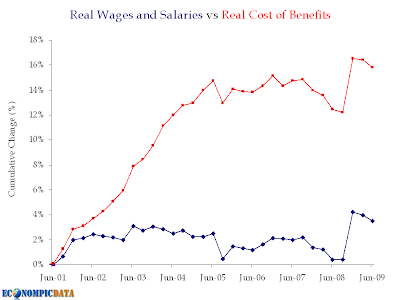
The real costs and benefits is essentially health care. If you were given the choice, wouldn't you rather have the cash? The sad part is most of this rise is inflating health care costs, not more or better health care.

The real costs and benefits is essentially health care. If you were given the choice, wouldn't you rather have the cash? The sad part is most of this rise is inflating health care costs, not more or better health care.
Monday, September 21, 2009
Interpreting the Second Amendment
My first post will be on an interesting linguistic interpretation issue that is having national reprecussions here in the U.S. This post will be summarizing issues with the second amendment that were brought up by Prof. Baron et. al. See the references below for more information.
The second amendment to the U.S. Constitution states:
A well regulated Militia, being necessary to the security of a free State, the right of the people to keep and bear Arms, shall not be infringed.
A modern English user will find the phrasing of this amendment quite clunky; in particular it seems like the phrase before the second comma (“A well regulated .... State,”) and after the comma (“, the right of the people... “) are two independent phrases that are just jammed together. For ease of discussion, let L1 refer to the first part and L2 refer to the second part.
Clearly the framers of the constitution were not English neophytes, thus this is not merely an “error” -- so what does it mean? We can view this at the grammatical and semantic level. From the grammatical point of view, L1 and L2 are grammatical independent. The question that mainly concerns us is whether the two phrases are semantically interdependent -- does the meaning of L1 affect the meaning of L2? There are two cases:
1) Semantically independent: L1 has no bearing on L2, it is merely “constitutional throat clearing” [Baron]. From this interpretation, we find that the 2nd amendment says that everyone should have the right to own a gun.
2) Semantically dependent: L1 impacts L2 in a if-then or cause-effect relationship. From this interpretation, it can be argued that the 2nd amendment only meant for state militia to have arms, and not everyone to have arms.
Clearly this grammatical difference has great import on national law! How do we decide which of these interpretations is correct? One way to do this is to try to understand the English of the founders. Prof. Baron does a great job of this in this article (from which most of this material is drawn).
To summarize some of his argument, English textbooks at the time discussed what is called the “absolute construction”, in which two phrases are grammatically independent and placed in a sentence. In particular he says:
“ In addition, grammarians from the 18th century down to the present affirm that the absolute construction invariable establishes a semantic dependence in a sentence.” [Baron]
I refer the reader to the post by Prof. Baron for more in depth examples.
The opposing argument, from an amicus brief filed by the opposing side, argues that L1 is merely providing context, but is not the *only* reason for protecting gun ownership. A great example from the brief is a passage in Article 3 of the Northwest Ordinance (written about the same time as the amendments):
“Religion, morality, and knowledge, being necessary to good government and the happiness of mankind, schools and the means of education shall forever be encouraged.“
Does this mean that schools should only be used for teaching religion, morality and knowledge?
Clearly, resolving this problem is not something that can be done easily. In this particular case, the Supreme Court viewed L1 as basically “constitutional throat clearing” [Baron] which does not affect the “meat” of the amendment.
It seems clear that the unambiguous interpretation of laws is, if not impossible, highly improbable. Readers add their own interpretations and biases, and we must recognize that and provide a means for the continual reinterpretation of historical documents.
As a side note, I think this case argues for the political need for research in liberal arts and sciences. When we interpret legal documents it is not just the words we must understand, but rather the context in which they were written. Language is a powerful tool, yet it is inherently a convention -- meaning of words and phrases are agreed upon by the users of language; and thus language can, and does, change as society changes. In order to understand a legal document, one must also understand the writers and the society they lived in.
And finally, take a look at the post by Prof. Baron for a much more in depth look at this issue: The Web of Language
The second amendment to the U.S. Constitution states:
A well regulated Militia, being necessary to the security of a free State, the right of the people to keep and bear Arms, shall not be infringed.
A modern English user will find the phrasing of this amendment quite clunky; in particular it seems like the phrase before the second comma (“A well regulated .... State,”) and after the comma (“, the right of the people... “) are two independent phrases that are just jammed together. For ease of discussion, let L1 refer to the first part and L2 refer to the second part.
Clearly the framers of the constitution were not English neophytes, thus this is not merely an “error” -- so what does it mean? We can view this at the grammatical and semantic level. From the grammatical point of view, L1 and L2 are grammatical independent. The question that mainly concerns us is whether the two phrases are semantically interdependent -- does the meaning of L1 affect the meaning of L2? There are two cases:
1) Semantically independent: L1 has no bearing on L2, it is merely “constitutional throat clearing” [Baron]. From this interpretation, we find that the 2nd amendment says that everyone should have the right to own a gun.
2) Semantically dependent: L1 impacts L2 in a if-then or cause-effect relationship. From this interpretation, it can be argued that the 2nd amendment only meant for state militia to have arms, and not everyone to have arms.
Clearly this grammatical difference has great import on national law! How do we decide which of these interpretations is correct? One way to do this is to try to understand the English of the founders. Prof. Baron does a great job of this in this article (from which most of this material is drawn).
To summarize some of his argument, English textbooks at the time discussed what is called the “absolute construction”, in which two phrases are grammatically independent and placed in a sentence. In particular he says:
“ In addition, grammarians from the 18th century down to the present affirm that the absolute construction invariable establishes a semantic dependence in a sentence.” [Baron]
I refer the reader to the post by Prof. Baron for more in depth examples.
The opposing argument, from an amicus brief filed by the opposing side, argues that L1 is merely providing context, but is not the *only* reason for protecting gun ownership. A great example from the brief is a passage in Article 3 of the Northwest Ordinance (written about the same time as the amendments):
“Religion, morality, and knowledge, being necessary to good government and the happiness of mankind, schools and the means of education shall forever be encouraged.“
Does this mean that schools should only be used for teaching religion, morality and knowledge?
Clearly, resolving this problem is not something that can be done easily. In this particular case, the Supreme Court viewed L1 as basically “constitutional throat clearing” [Baron] which does not affect the “meat” of the amendment.
It seems clear that the unambiguous interpretation of laws is, if not impossible, highly improbable. Readers add their own interpretations and biases, and we must recognize that and provide a means for the continual reinterpretation of historical documents.
As a side note, I think this case argues for the political need for research in liberal arts and sciences. When we interpret legal documents it is not just the words we must understand, but rather the context in which they were written. Language is a powerful tool, yet it is inherently a convention -- meaning of words and phrases are agreed upon by the users of language; and thus language can, and does, change as society changes. In order to understand a legal document, one must also understand the writers and the society they lived in.
And finally, take a look at the post by Prof. Baron for a much more in depth look at this issue: The Web of Language
Moral Hazard: The Gift That Keeps On Giving
I love the concept of karma - the idea that you do an action and the consequence depends on your action. It is just so clean. Systems that employ karma as the guiding principle for how they operate work so well! We do use this idea in various aspects of our society: We create laws such that people who harm others are punished. People who make productive contributions in their job can look forward to better earnings. People who drive carefully get better auto insurance rates.
However, when it comes to the karmic balance of our economy... well I’m not sure it exits anymore. The recent bailouts have tossed out this relationship of action and its consequences. The bailouts repulse me in many ways: first of all the govt is taking ownership in private enterprises, secondly the companies that are being bailed out have very little probability of producing any returns greater than or equal to zero, thirdly the govt doesn’t have the money!
As much as these reasons upset me, the one thing that scares me is the amount of moral hazard* now prevalent in our economy. The idea that if you make bad decisions you will suffer for it, is no longer true! Because of the bailouts, especially of the auto industry, we have removed karma as our guiding principle. What incentives do people or companies have now to manage their risk and to make good decisions? We have created a system that allows for companies to make terrible decisions without them worrying about the consequences. Rather, we have created a system where the consequences of actions have changed, and incentives are altered.
Suppose you have a situation where two events are possible. You can make a lot of money say $X with 60% probability and you can loose a lot of money say –$X with a 40% probability. Suppose, now, the situation has changed (as in the case of the bailouts). The probabilities and the amounts are the same, but what you will experience is changed. Instead of experiencing –$X profit you will end up with $0 and the government as your new owner. How will this influence your decisions?
I am not claiming that in all situations and all companies will make more risky decisions because they might feel like the government will bail them out. In depends on how –$X relates to ‘$0 and the government as the new owner’. Maybe having the government as your new owner is worse. If all other companies in your industry are functioning well and don’t need to be bailed out, but you do, then maybe it is far worse to have the government as your owner. But if all other companies in your industry are being bailout out... what kind of decisions are you going to make?
Since I am an Actuary, I love making predictions based on trends. So, here is my prediction: Many more companies will make bad decisions based on their new found security of the bailouts (at least in the short term future). Of course these companies will probably make rational decisions based on their risk analysis, but people will see them as being greedy and unreliable. And greed is bad right? So maybe we will venture off again on our quest to find the magic pill to get rid of it. And reliable? I wonder why companies don’t like to make decisions that will be similar to suicide, even though they would be doing it for the good of society. Oh well, atleast it will give us some ammunition in our fight against "Corporate America". And THIS can most definitely help the Democrats to usher in a new era of socialism.
*Moral hazard is the change in the behavior of people and organizations when their share of loss is reduced.
However, when it comes to the karmic balance of our economy... well I’m not sure it exits anymore. The recent bailouts have tossed out this relationship of action and its consequences. The bailouts repulse me in many ways: first of all the govt is taking ownership in private enterprises, secondly the companies that are being bailed out have very little probability of producing any returns greater than or equal to zero, thirdly the govt doesn’t have the money!
As much as these reasons upset me, the one thing that scares me is the amount of moral hazard* now prevalent in our economy. The idea that if you make bad decisions you will suffer for it, is no longer true! Because of the bailouts, especially of the auto industry, we have removed karma as our guiding principle. What incentives do people or companies have now to manage their risk and to make good decisions? We have created a system that allows for companies to make terrible decisions without them worrying about the consequences. Rather, we have created a system where the consequences of actions have changed, and incentives are altered.
Suppose you have a situation where two events are possible. You can make a lot of money say $X with 60% probability and you can loose a lot of money say –$X with a 40% probability. Suppose, now, the situation has changed (as in the case of the bailouts). The probabilities and the amounts are the same, but what you will experience is changed. Instead of experiencing –$X profit you will end up with $0 and the government as your new owner. How will this influence your decisions?
I am not claiming that in all situations and all companies will make more risky decisions because they might feel like the government will bail them out. In depends on how –$X relates to ‘$0 and the government as the new owner’. Maybe having the government as your new owner is worse. If all other companies in your industry are functioning well and don’t need to be bailed out, but you do, then maybe it is far worse to have the government as your owner. But if all other companies in your industry are being bailout out... what kind of decisions are you going to make?
Since I am an Actuary, I love making predictions based on trends. So, here is my prediction: Many more companies will make bad decisions based on their new found security of the bailouts (at least in the short term future). Of course these companies will probably make rational decisions based on their risk analysis, but people will see them as being greedy and unreliable. And greed is bad right? So maybe we will venture off again on our quest to find the magic pill to get rid of it. And reliable? I wonder why companies don’t like to make decisions that will be similar to suicide, even though they would be doing it for the good of society. Oh well, atleast it will give us some ammunition in our fight against "Corporate America". And THIS can most definitely help the Democrats to usher in a new era of socialism.
*Moral hazard is the change in the behavior of people and organizations when their share of loss is reduced.
Saturday, September 5, 2009
A sudden, terrifying realization swept over me this morning!
A prime virtue of Liberty is that by not interfering in peoples triumphs and failures, capital naturally flows to those who know how to use it. With each bad decision people become less able to affect the rest of us.
In our current system the Bailout short-circuits this mechanism. If you cross some unseen and undefined line and become too big (or too well connected) to fail, you are paid for your losses by the rest of us. So now there are two classes of people. In one group, the mega-well-connected, you keep your gains but pass off your losses. In another, the rest of us, you keep you gains, and your losses, and their losses.
Bailout is the evil bastard child of Capitalism and Socialism that is far worse, and unjust, then both. It is far worse than any tax hike or universal healthcare option and must be opposed as such. Bailout’s true power to destroy comes from its tendency to dress up in its father cloths. Because this bastard child is allowed to present itself in Capitalism’s name, the only “rational” choice left is Socialism.
This is a threat to your liberty and must be opposed. It will not be enough to complain to your friends and relatives. Something must be done. It will not be enough to write your congressman, because your congressman has been bought for a pittance. The list of campaign contributors before bailout (here and here) is -- Surprise! -- a veritable who’s who of bailout recipients! After Bailout, these very companies are dealing a percentage of the handout back to the very congressmen who gave it to them in the first place!
So I urge you to do two things: First, write you Congressman and Senators. Let them know that you are not happy with the bailout not just because it is inherently unjust, but because you see the bigger implications mentioned above. Also let them know that you know who really butters their bread by looking up their campaign contributions here. Second, I don’t think the above will be enough to make sure this never happens again, so please comment below on your thoughts on how we as citizens can resist.
In closing, allow me to note the haunting similarities between our situation and Arthurian legend. We capitalists stand like Arthur ready to walk down the length of the spear to kill this monster; this child that was created through deception by a vengeful mother for the express purpose of ridding the world of the father. Like Mordred this child will wipe its father from this earth for a thousand years if it’s not put down early and without mercy. Let us not walk down that spear. Let us lift our head from the shortsightedness of battle and recognize this evil for what it is before it is too late.
In our current system the Bailout short-circuits this mechanism. If you cross some unseen and undefined line and become too big (or too well connected) to fail, you are paid for your losses by the rest of us. So now there are two classes of people. In one group, the mega-well-connected, you keep your gains but pass off your losses. In another, the rest of us, you keep you gains, and your losses, and their losses.
Bailout is the evil bastard child of Capitalism and Socialism that is far worse, and unjust, then both. It is far worse than any tax hike or universal healthcare option and must be opposed as such. Bailout’s true power to destroy comes from its tendency to dress up in its father cloths. Because this bastard child is allowed to present itself in Capitalism’s name, the only “rational” choice left is Socialism.
This is a threat to your liberty and must be opposed. It will not be enough to complain to your friends and relatives. Something must be done. It will not be enough to write your congressman, because your congressman has been bought for a pittance. The list of campaign contributors before bailout (here and here) is -- Surprise! -- a veritable who’s who of bailout recipients! After Bailout, these very companies are dealing a percentage of the handout back to the very congressmen who gave it to them in the first place!
So I urge you to do two things: First, write you Congressman and Senators. Let them know that you are not happy with the bailout not just because it is inherently unjust, but because you see the bigger implications mentioned above. Also let them know that you know who really butters their bread by looking up their campaign contributions here. Second, I don’t think the above will be enough to make sure this never happens again, so please comment below on your thoughts on how we as citizens can resist.
In closing, allow me to note the haunting similarities between our situation and Arthurian legend. We capitalists stand like Arthur ready to walk down the length of the spear to kill this monster; this child that was created through deception by a vengeful mother for the express purpose of ridding the world of the father. Like Mordred this child will wipe its father from this earth for a thousand years if it’s not put down early and without mercy. Let us not walk down that spear. Let us lift our head from the shortsightedness of battle and recognize this evil for what it is before it is too late.
Sunday, August 23, 2009
Concentrated Benifits, Dispersed Costs.
Ok, I'm excited about my first post but don't have much to say. so below is a HI-Larious video on Cash for Clunkers. The relatively small amount dedicated to cash for clunkers means its probably less damaging then the huge bailouts of the financials, but the concrete nature of the business make the theft involve much more obvious and easy to understand. I think there is something important in this idea of concentrated benefits, dispersed costs...
Trisco
Trisco
Subscribe to:
Posts (Atom)

 Posts
Posts

